


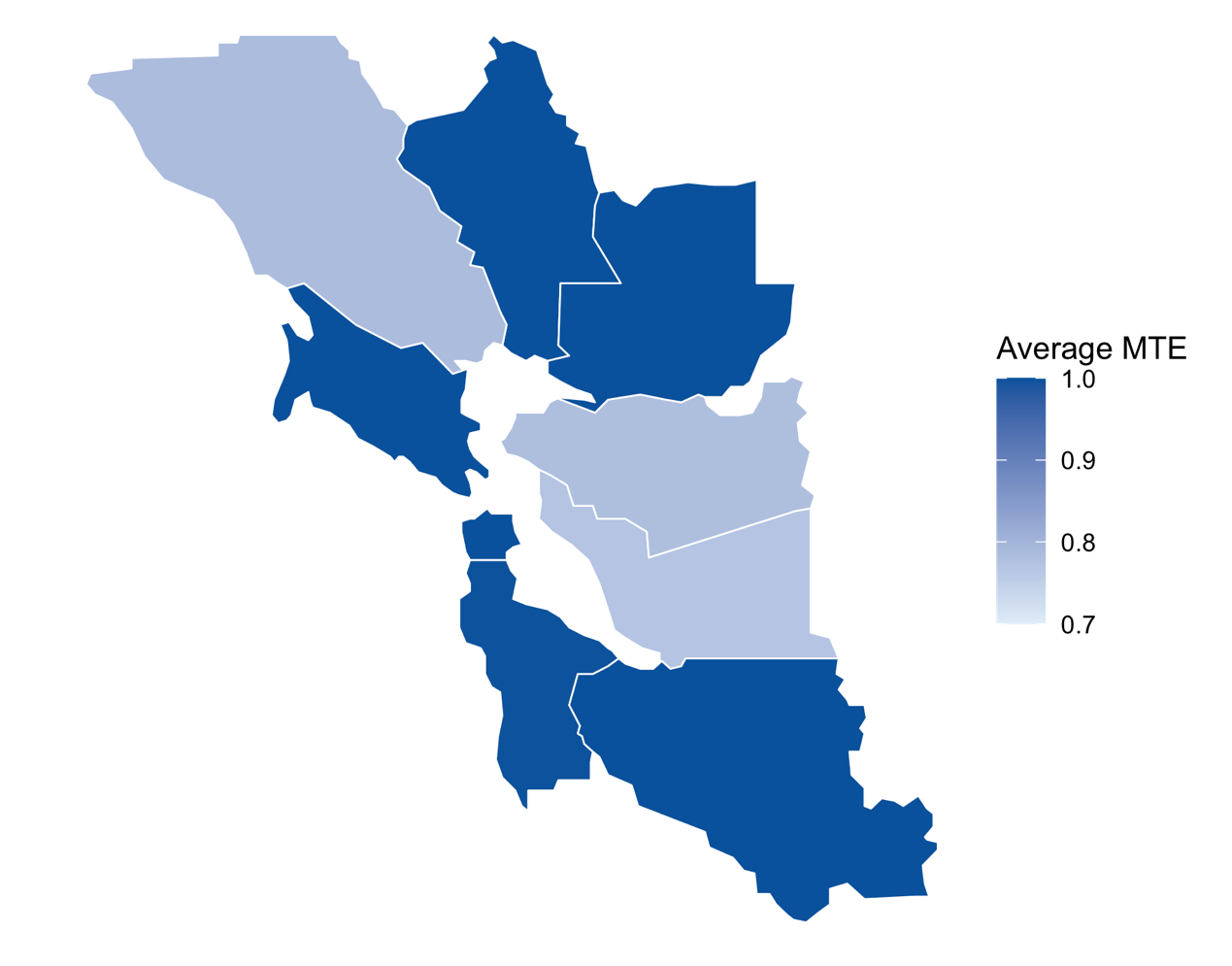
This study benchmarks green efficiency in the Yangtze River Delta (YRD) in China and the San Francisco Bay Area (SFBA) in the United States to diagnose whether emerging megaregions' green gap reflects managerial inefficiency or technological backwardness. Using a Slacks-Based Measure (SBM) model with undesirable outputs within a meta-frontier framework, it decomposes Meta-Frontier Efficiency (MTE) into Group Technical Efficiency (GTE) and the Technology Gap Ratio (TGR) for 35 cities and counties over 2004 to 2023. The two agglomerations achieve nearly identical managerial efficiency, with average GTE of 0.920 and 0.914, but the SFBA's MTE of 0.920 far exceeds the YRD's 0.795. This gap stems from technology: the SFBA's TGR is 1.000, meaning its group frontier coincides with the global meta-frontier, whereas the YRD's TGR is only 0.873 and has widened over time. Spatial autocorrelation analysis reveals no significant clustering of green productivity, indicating that green technologies are highly localized and do not diffuse spontaneously across city boundaries, so that economic integration has outpaced environmental and technological integration. These findings imply that the YRD should shift its policy focus from managerial tightening toward green technology research and development, and promote policy-driven green technology transfer from leading cities to peripheral manufacturing ones.