

About JAEPSJournal of Applied Economics and Policy Studies (JAEPS) is an open-access, peer-reviewed monthly academic journal hosted by the Peking University Research Centre for Market Economy (RCME) and published by EWA Publishing. Centered on real-world economic practice, the journal integrates three core research dimensions: practical application of economic theories, measurable economic output of empirical research, and evidence-backed policy formulation value of rigorous academic outputs. Beyond economic and decision-making value, it highlights industrial empowerment, standardized governance, cross-border exchange and demonstration promotion value of economic research; these multi-layered research values are delivered to university economics researchers, government economic policymakers, enterprise industrial consultants and financial analysts via standardized quantitative research paradigms, industrial decision references and cross-border academic communication channels.For more details of the JAEPS scope, please refer to the Aim&Scope page. For more information about the journal, please refer to the FAQ page or contact info@ewapublishing.org. |
| Aims & scope of JAEPS are: ·Economics ·Management ·Finance & Accounting ·Interdisciplinary Fields |
Article processing charge
A one-time Article Processing Charge (APC) of 450 USD (US Dollars) applies to papers accepted after peer review. excluding taxes.
Open access policy
This is an open access journal which means that all content is freely available without charge to the user or his/her institution. (CC BY 4.0 license).
Your rights
These licenses afford authors copyright while enabling the public to reuse and adapt the content.
Peer-review process
Our blind and multi-reviewer process ensures that all articles are rigorously evaluated based on their intellectual merit and contribution to the field.
Editors View full editorial board

Beijing, China
xqin@pku.edu.cn

London, UK
canh.dang@kcl.ac.uk

Edinburgh, UK
B.Adamolekun@napier.ac.uk

Macau, China
qiangli@cityu.edu.mo
Latest articles View all articles
This paper investigates how three features of board structure relate to financial reporting misconduct in China. The analysis covers 63,650 firm-year observations for A-share companies between 2000 and 2025 and considers the proportion of independent directors, the combination of the CEO and board-chair positions, and female representation on the board. Financial restatement serves as the observable measure of misconduct. The estimates show that CEO duality is associated with fewer restatements. Board independence also has a negative coefficient, although the association weakens and loses statistical significance when the other board attributes are included. Female board representation has the most stable result: firms with more female directors have a significantly lower probability of restatement. Additional tests indicate that ownership type moderates the association with CEO duality but not the associations with board independence or female representation. These results show that board attributes differ in their relation to reporting outcomes and that the consequences of leadership structure depend on institutional context.

 View pdf


After selecting data of Montage Technology from 2021 to 2025, one can observe a growth process that is not neatly linear. The overall scale expanded over the five years, yet the differences between years were large. Based mainly on the company's annual reports, this paper continuously observes the changes in operating revenue, profit, R&D expenses, assets, and equity, and uses relevant data from the Science and Technology Innovation Board as a reference. There is a time lag between input and output in the chip design business: R&D occurs first, and sales may only form after sample production, validation, and customer introduction are completed; meanwhile, fluctuations in the server and storage markets also affect orders. In 2023, the company's revenue and profit clearly fell, and then recovered in 2024–2025 with the DDR5 upgrade, shipment of new products, and increased demand from AI servers. In 2025, operating revenue grew 49.94% year-on-year and R&D investment intensity was 16.77%. Therefore, this paper's judgment of the company is not simply "fast growth", but rather a strong growth foundation coupled with pronounced volatility; customer structure, revenue sources, and the external manufacturing dependence under the Fabless model still require continued attention.
View pdf
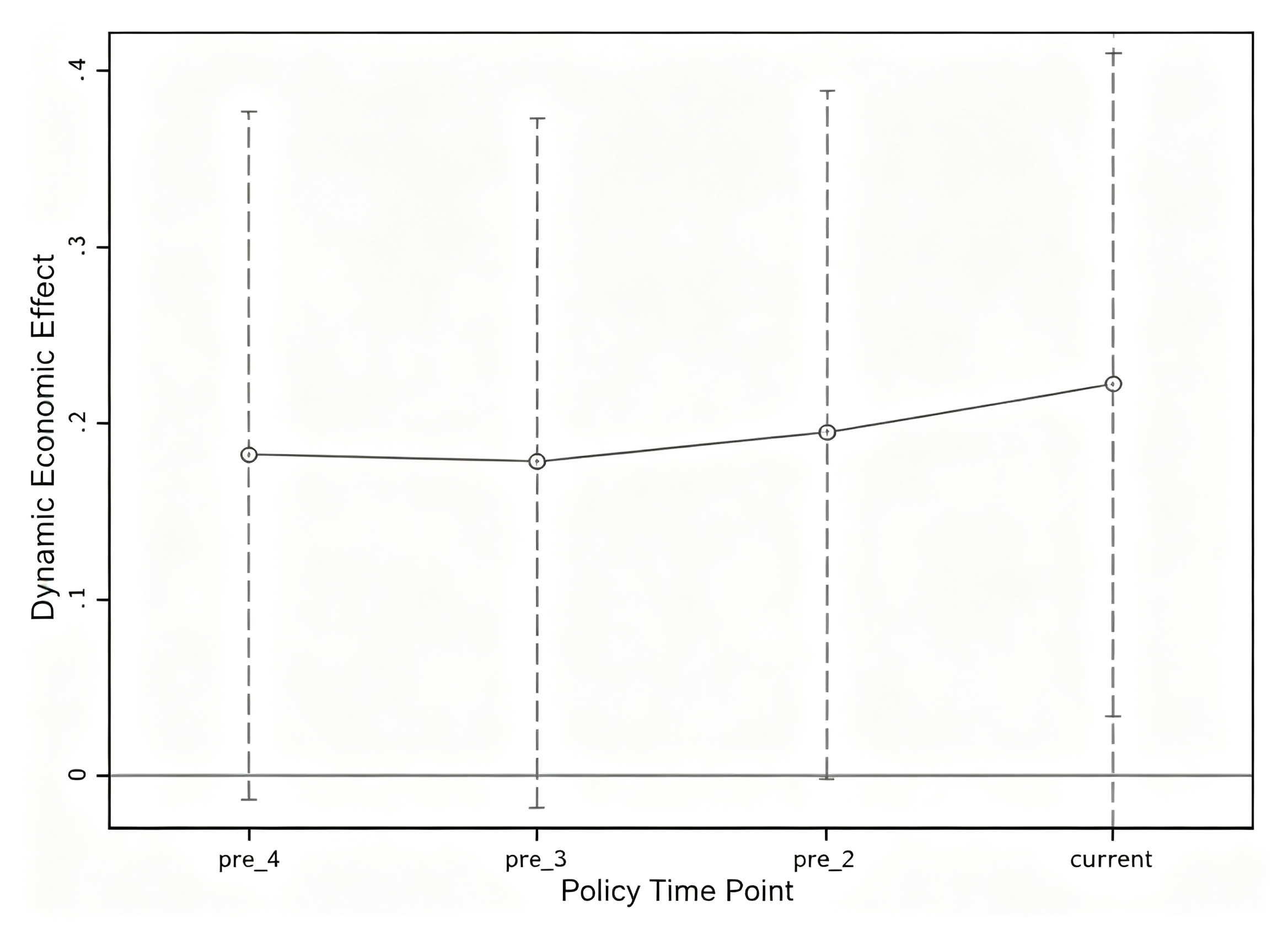
This study employs the Difference-in-Differences (DID) method, using the 2025 Jiangsu City Football Super League ("Jiangsu Super League") as a quasi-natural experiment to rigorously examine the net effect of the Jiangsu City Football Super League on the regional economy. The study constructs an econometric model that includes time effects, regional effects, and interaction terms, and then conducts robustness tests and heterogeneity analysis. The findings show that the establishment of the Jiangsu City Football League significantly promoted the growth of the tertiary industry value-added in Jiangsu Province, with a relative growth rate of approximately 20.28%; the effect is particularly pronounced in medium and small cities such as Taizhou and Suqian. This economic benefit is fully verified by the parallel trends test and robustness tests, has high causal credibility, and provides new insights for the development of the tertiary industry in other cities.
View pdf
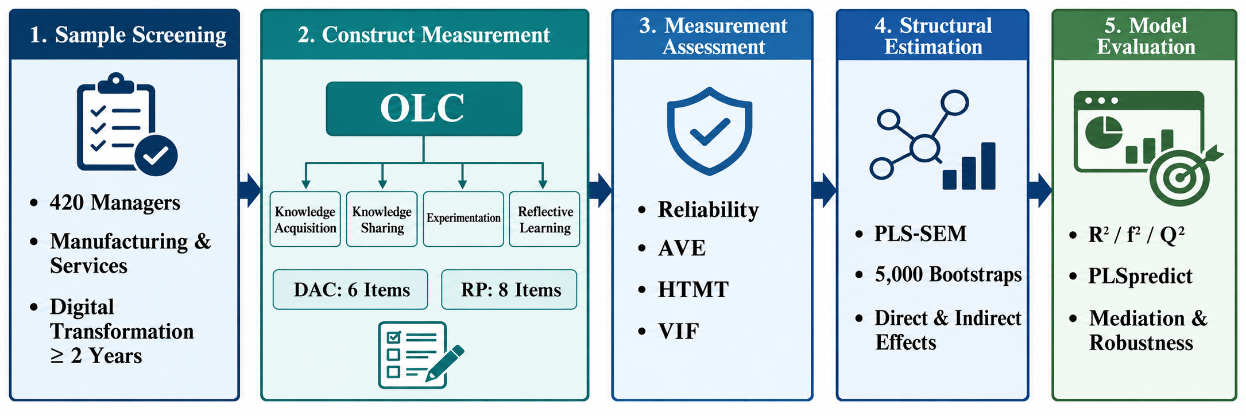
Digital transformation opens up more opportunities for organizational access to information, automation, and platform-enabled coordination, but it also creates risks of exposure to the unpredictability of technology and dependency on others. The present study tests if organizational learning capacity enhances organizational resilience performance directly and indirectly through digital adaptive capacity. Cross-sectional survey methodology is defined for a sample of 420 middle and senior managers from Chinese manufacturing and service firms which have been undergoing enterprise-wide digital transformation for at least two years. Organizational learning capacity is conceptualized as a second-order latent variable made up of knowledge acquisition, knowledge sharing, experimentation, and reflective learning. Partial least squares structural equation modeling with 5,000 bootstrap resamples is used for assessment of measurement properties, direct relationships, mediation, explanation capacity, and prediction accuracy. In a simulated 420-case study, organizational learning capacity positively predicts digital adaptive capacity (β = 0.648***), digital adaptive capacity positively predicts resilience performance (β = 0.463***), and the indirect effect is equal to β = 0.300**. The model accounts for 62.4% of the variation in resilience performance. The results suggest that learning helps build resilience through quick adaptation of technologies, processes, and decision-making.
View pdf
Volumes View all volumes
2026
Volume 19October 2026
Find articlesVolume 19April 2026
Find articlesVolume 19March 2026
Find articles2025
Volume 18May 2025
Find articlesVolume 18September 2025
Find articlesVolume 18August 2025
Find articlesAnnouncements View all announcements
Journal of Applied Economics and Policy Studies
We pledge to our journal community:
We're committed: we put diversity and inclusion at the heart of our activities...
Journal of Applied Economics and Policy Studies
The statements, opinions and data contained in the journal Journal of Applied Economics and Policy Studies (JAEPS) are solely those of the individual authors and contributors...
Indexing
The published articles will be submitted to following databases below: