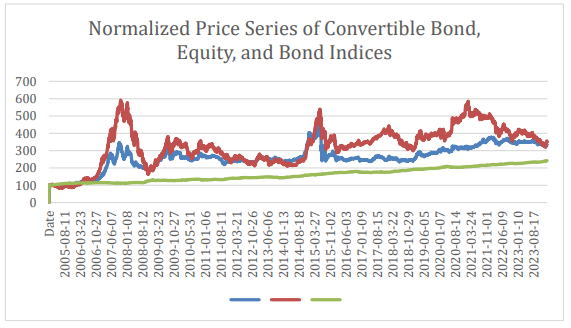
Chinese convertible bonds are examined in two settings: portfolio construction and relative-value trading. At the portfolio level, a convertible bond index is compared with the HS300 equity index and a broad bond index over 2005–2024 using return, volatility, Sharpe ratio, maximum drawdown, illustrative allocations, and mean–variance frontiers. The convertible bond index earns a return close to equities with lower volatility and a smaller drawdown, while allocations containing convertibles record higher Sharpe ratios than the stock–bond benchmark. At the trading level, mispricing is defined as the gap between GARCH volatility estimated from the underlying stock and the implied volatility embedded in the bond price. A positive gap indicates that the conversion option is priced at a lower volatility than the stock estimate. Following a static delta-hedged Feikai CB example, fixed market-wide thresholds are compared with bond-specific expanding-window percentile rules based only on information available at each date. With a P50 exit, clean-convergence trades increase from 945 to 1,415 and the timeout share falls from 25.0% to 9.4%. The contrast between CITIC and Wencan shows that spread dispersion, rather than spread level alone, is important for determining whether apparent mispricing can be traded.