
Articles in this Volume

Research Article Open Access
A study on improving the acquisition efficiency of supermarket promotion information based on agent workflow orchestration
Article thumbnail
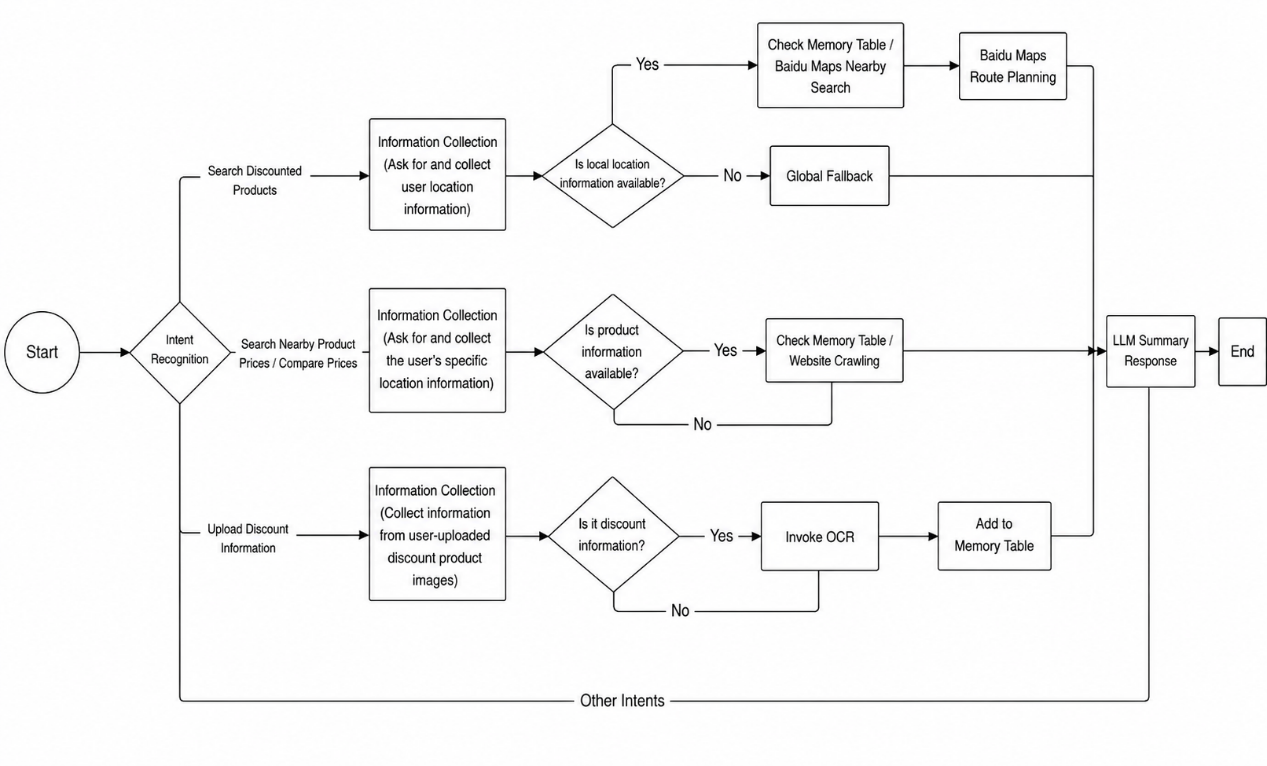
Retail promotion stacking and price confusion have intensified search frictions, exposing the fragility of conventional rule-based approaches. This study proposes a supermarket discount decision support system that replaces multi-agent architectures prone to intention drift with a dual-model collaborative framework, decoupling intent routing from conversational generation. The system integrates three key mechanisms. First, a structured interaction scaffold is constructed to reduce ambiguity in user inputs. Second, a dynamic fallback and replanning loop is designed to evaluate the confidence of CNN-based Optical Character Recognition (OCR) in real time, enabling autonomous global rerouting whenever confidence falls below a predefined threshold to improve robustness. Third, a memory table is introduced for data consistency verification, establishing a risk-control foundation through a traceable closed loop that spans image feature extraction, cross-validation against publicly available data, and confidence assessment. Experimental results demonstrate that, compared with the 8–10 operational steps typically required in manual workflows, the fully orchestrated system (Agent_full) consistently compresses highly constrained tasks into two interaction steps. The success rate of the T2 price comparison task reaches 86.96%, significantly outperforming B2 (46.15%) and A2 (73.08%). Although task completion time increases to 159.09 seconds, the system achieves higher-quality outcomes and minimal user interaction by shifting the cognitive burden of decision-making from users to system-level computation.
Show more
Read Article PDF
Cite
Research Article Open Access
Research on strategies for improving cold chain logistics in Dalian under the community group buying model
With the advancement of the digital era, community group buying has emerged as a new form of e-commerce. It has developed rapidly across China and has gradually become an important component of the retail market. As a major economic center in Northeast China, Dalian has witnessed the rapid growth of the community group buying market, which has not only transformed the consumption habits of urban residents but also demonstrated the vitality of this business model. The rise of community group buying has brought greater convenience to consumers while simultaneously creating both challenges and opportunities for traditional retail industries. However, with the rapid expansion of the market, community group buying has also encountered a series of problems, including insufficient transportation network coverage and unscientific route selection, all of which have affected its long-term development. This paper conducts an in-depth discussion of the current status of the community group buying distribution model in Dalian, the problems existing within it, and the corresponding countermeasures and recommendations. The study aims to provide valuable references for the development of community group buying in Dalian and across China, thereby promoting the healthy and sustainable growth of this model.
Show more
Read Article PDF
Cite