Articles in this Volume

Research Article Open Access
Corporate governance and operational management optimization in private biotechnology enterprises
As a vital force within China's strategic emerging industries, private biotechnology enterprises play a crucial role in advancing technological innovation and economic development. At the same time, they face dual challenges arising from the industry's inherent characteristics—namely high investment, high risk, and long development cycles—and from deficiencies in internal governance mechanisms. From the perspective of corporate governance, this paper systematically examines the current conditions and core issues faced by private biotechnology enterprises in areas such as internal control, digital transformation, financing efficiency, cost management, capital control, and diversification strategies. The study finds that these enterprises commonly exhibit problems including imperfect governance structures, weak internal control environments, limited financing channels, significant talent attrition, lagging brand development, and the phenomenon of diversification discount. In response, this paper proposes a set of integrated optimization pathways, including improving ownership structure and corporate governance frameworks, strengthening internal control systems, advancing digital transformation, establishing lean cost management systems, broadening financing channels, and implementing moderate diversification strategies. The aim is to provide both theoretical reference and practical guidance for enhancing governance efficiency and operational management in private biotechnology enterprises.
Show more
Read Article PDF
Cite
Research Article Open Access
A comparison of the impact of review sentiment differences on sales under different sales modes—taking Douyin and Taobao as examples
Article thumbnail
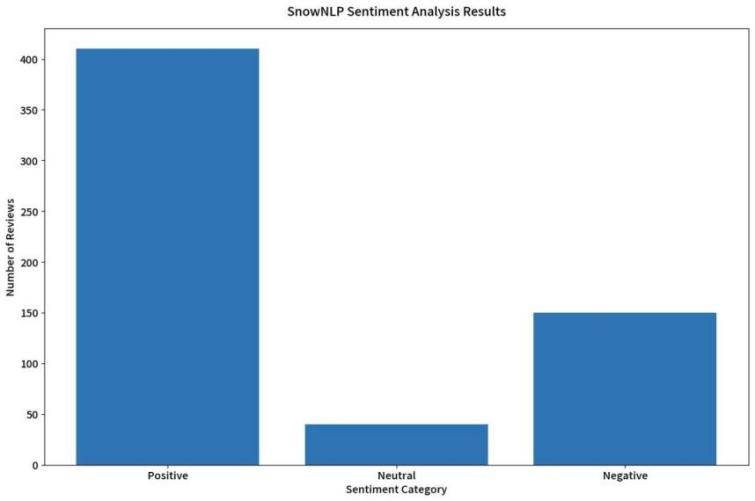
Online review sentiment exerts a crucial influence on consumers' purchase decisions, yet systematic comparisons of the distribution differences of review sentiment under different sales modes and their influencing mechanisms on sales remain insufficient. This study takes as the research objects and the product "Advanced Night Repair Eye Supercharged (5th Generation)" of the brand Estée Lauder as a case study. A total of 1,200 product reviews (600 from Douyin and 600 from Taobao) were collected. SnowNLP was adopted for sentiment analysis, the Kolmogorov-Smirnov (KS) test was used to compare the sentiment distribution differences between the two platforms, and multiple regression was applied to test the moderating effect of platform type on the sentiment-sales relationship. The results show that there is no significant difference in the distribution of review sentiment scores between the two platforms; sentiment scores have a significant positive impact on sales conversion. The study indicates that despite the convergent sentiment distribution, the effectiveness of sentiment varies across platforms. This research provides theoretical support for the brand review effects of different sales modes across platforms.
Show more
Read Article PDF
Cite
Research Article Open Access
Exploring operational and management strategies for medical technology enterprises
With the in-depth advancement of the "Healthy China" strategy and the accelerating aging of the population, China's healthcare industry has entered a period of unprecedented development opportunities. As the core drivers of this sector, medical technology enterprises are benefiting from market expansion while simultaneously facing multiple challenges, including tightening regulatory policies, intensified competition, and rapid technological iteration. Traditional management models are increasingly inadequate for meeting these new demands. Based on observations of operational practices in medical technology enterprises, this paper systematically analyzes common issues in financial management, cost control, human resource management, and quality management. It further proposes a set of comprehensive management strategies from multiple dimensions, including optimizing capital management, implementing comprehensive budgeting, strengthening cost control, establishing dual-factor incentive mechanisms, improving quality management systems, and promoting digital transformation. The aim is to provide both theoretical references and practical insights for enhancing core competitiveness and achieving high-quality development in medical technology enterprises.
Show more
Read Article PDF
Cite
Research Article Open Access
Research on the paths and mechanisms of a circular economy empowering the "Dual Carbon" strategy
Article thumbnail
Circular economy represents a crucial development domain for China to promote energy conservation and emission reduction, as well as to efficiently advance carbon peaking and carbon neutrality. This study aims to explore the implementation paths and practical effects of circular economy empowering the "Dual Carbon" strategy, with the Circular Economy Industrial Park in Quetang Town, Hunan Province as the research object. By comprehensively applying the Analytic Hierarchy Process (AHP), fuzzy comprehensive evaluation and case study methods, this research systematically analyzes the energy conservation and emission reduction mechanisms of the secondary aluminum industry. The findings indicate that circular economy can significantly reduce energy consumption and carbon emission intensity of traditional energy-intensive industries through three major paths: resource recycling and reuse, clean energy substitution, and collaborative optimization of the industrial chain. Meanwhile, it lessens the dependence on primary resources and drives regional green and low-carbon transformation. The conclusions demonstrate that circular economy is one of the core paths to achieve the "Dual Carbon" goals. Its large-scale promotion can provide a replicable practical paradigm for industrial upgrading and sustainable development, which carries important policy reference significance.
Show more
Read Article PDF
Cite
Research Article Open Access
The impact of employment quality on fertility intention for additional children—from the dual perspectives of job stability and career development
To address the dilemma of low fertility rate and explore the mechanism of employment quality on the fertility intention for additional children of childbearing-age groups, this study conducts research based on 2,189 valid samples of non-agricultural employed married childbearing-age groups with children, using quantitative analysis combined with heterogeneity test and endogeneity treatment. The results show that career development serves as a crucial risk buffer for women's fertility intention for additional children; the number of existing children significantly inhibits fertility intention for additional children through the increasing marginal parenting cost; the positive driving effect of career development is more prominent in non-urban groups and middle managers; job stability exerts a certain negative impact on men's fertility intention for additional children. The study indicates that it is necessary to build a differentiated fertility support system centered on career development empowerment, gender rights protection, and multi-child cost sharing, so as to provide a reference for promoting the long-term balanced development of the population.
Show more
Read Article PDF
Cite
Research Article Open Access
Downside-driven abnormal performance asymmetry and its family-level persistence: evidence from Chinese mutual funds
Using data on Chinese mutual funds from 2005 to 2025, this study constructs delta alpha, defined as the difference between downside-period alpha and upside-period alpha, to measure asymmetry in abnormal performance across market states. By shifting abnormal performance from an unconditional perspective to a state-dependent cross-sectional object, delta alpha characterizes how alpha is distributed across market environments rather than averaged over them. This study finds that performance asymmetry exhibits a one-sided structure: cross-sectional variation is driven almost entirely by downside-period alpha, while upside-period alpha displays minimal variation. Benchmark fit (R²) significantly dampens downside-period alpha but does not explain differences in max-drawdown, suggesting that delta alpha captures relative performance structure rather than absolute risk exposure. Further analysis incorporating fund-family fixed effects shows that performance asymmetry clusters significantly among defensive families, even after controlling for fund size, age, benchmark fit, and max-drawdown. This study finds that abnormal performance under stress is better characterized as an organizational feature rather than purely individual manager skill; performance evaluation should therefore incorporate fund-family investment styles and internal capital allocation mechanisms.
Show more
Read Article PDF
Cite
Research Article Open Access
Research on the operational status, problems, and breakthrough strategies of XPeng Motors
With the rapid development of the new energy vehicle industry and increasingly fierce market competition, XPeng Motors, a representative of domestic intelligent electric vehicle enterprises, is facing multiple challenges, including financial conditions, market competition, and operational efficiency. Based on XPeng Motors' operational data from 2019 to 2023, this paper adopts data analysis, comparative analysis, and other research methods to focus on analyzing its financial performance, market layout, product structure, and core problems and proposes targeted breakthrough strategies. The study finds that XPeng Motors has problems such as continuous losses, a high asset-liability ratio, insufficient market share, and low operational efficiency. Its Z-score is in the bankruptcy zone, indicating high financial risks. However, it has certain advantages in intelligent driving technology and segmented market layout. By optimizing the financial structure, strengthening brand awareness, and improving operational efficiency, XPeng Motors is expected to achieve profitability and enhance market competitiveness. The research results can provide reference for the development of XPeng Motors and similar new energy vehicle enterprises.
Show more
Read Article PDF
Cite
Research Article Open Access
Professional regulation, bureaucratic inertia, and the public interest: a social innovation perspective
This paper examines the tension between professional regulation as a mechanism of public protection and regulation as a source of bureaucratic rigidity that may impede socially valuable innovation. Professional regulation is ordinarily justified on the grounds that it promotes safety, fairness, competence, accountability, and public trust. At the same time, regulatory systems may become excessively procedural, resource-intensive, and insufficiently responsive to changing public needs. The paper argues that the central issue is not regulation itself, but the point at which regulation becomes detached from substantive public purposes and increasingly oriented toward compliance, defensibility, and institutional continuity. Drawing on scholarship in regulation theory, public administration, institutional theory, street-level bureaucracy, and social innovation, the paper analyzes how rules may function both as safeguards and as barriers. Particular attention is given to social entrepreneurs, whose work highlights the tension between compliance and innovation in public-interest sectors. The paper asks when regulation protects the public interest, when it substitutes procedure for accountability, how social entrepreneurs navigate these constraints, and what forms of reform might better align professionalism, legitimacy, and public impact. It concludes that the most promising response is not deregulation, but regulatory redesign that is proportionate, outcome-oriented, procedurally fair, and adaptive enough to support ethical and inclusive social innovation.
Show more
Read Article PDF
Cite
Research Article Open Access
A review of recent developments in ESG and corporate finance
The integration of Environmental, Social, and Governance (ESG) considerations into corporate finance has generated extensive yet fragmented research. Existing findings are heterogeneous, and causal claims are often undermined by measurement noise, selection bias, and pronounced ESG rating divergence. This lack of consensus obscures the mechanisms through which ESG affects firm value. To address this gap, this paper reviews recent developments by organizing evidence around five transmission channels: information, risk management, stakeholder relations, innovation, and capital allocation. Focusing on studies with credible identification, the review synthesizes findings on financial performance, cost of capital, climate risk, disclosure, governance, and engagement. The analysis reveals that ESG value creation is conditional, depending systematically on industry materiality, governance quality, and institutional context. The most robust evidence supports ESG's role in reducing financing costs and mitigating tail risks, while evidence of persistent alpha remains mixed. By clarifying boundary conditions and mechanisms, this review provides an integrated framework that reconciles prior inconsistencies. The paper concludes with implications for managers, investors, and policymakers and outlines promising frontiers in climate finance and machine-learning-based measurement. This synthesis thus offers a structured foundation for future theoretical and empirical inquiry.
Show more
Read Article PDF
Cite
Research Article Open Access
Development trends, fundamental characteristics, and impact analysis of financial technology
Article thumbnail
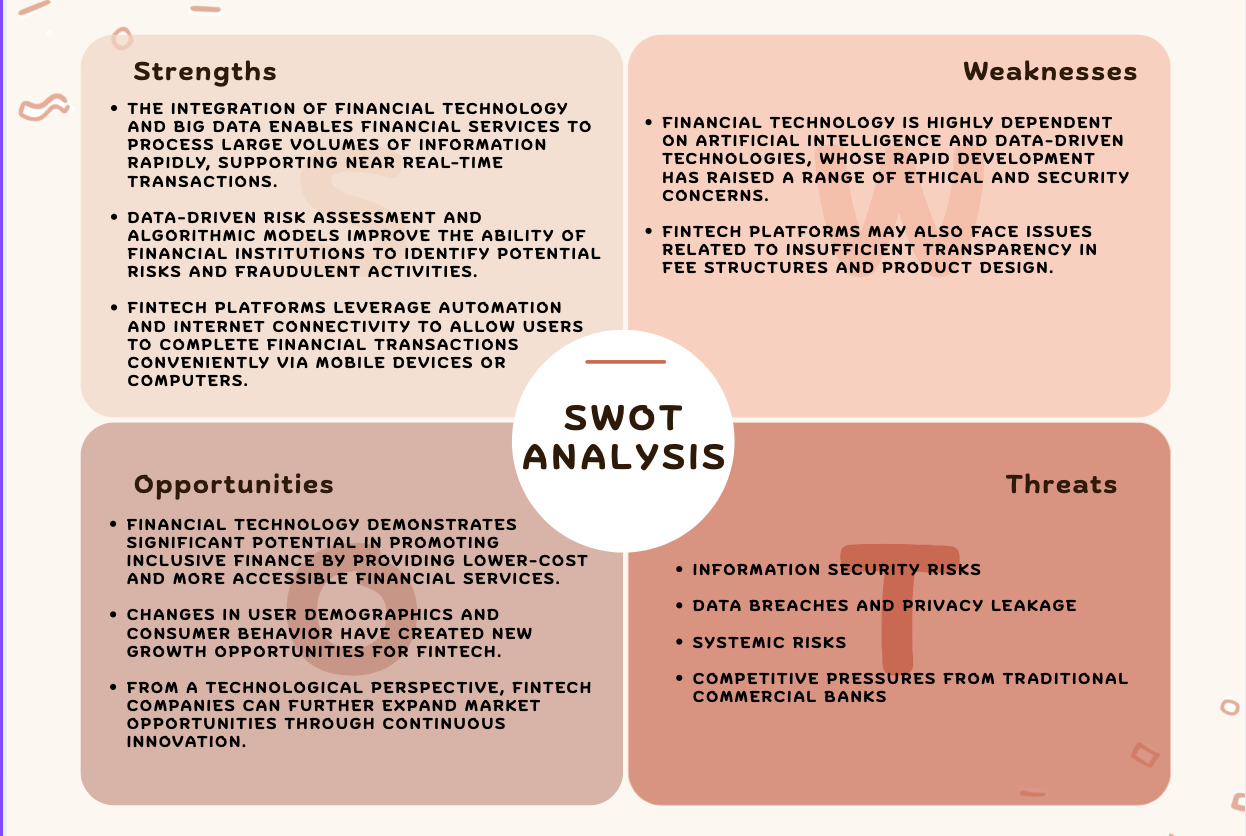
With the rapid advancement of digital technologies, Financial Technology (FinTech) is profoundly reshaping the operational paradigm of traditional financial systems and exerting wide-ranging influence across multiple domains, including payments, banking, investment management, and digital assets. This paper systematically examines the developmental trajectory of FinTech and its key technological drivers, with particular emphasis on its transition from early-stage back-end technical support to a consumer-centric financial service model. Building upon this foundation, a comprehensive evaluation is conducted using the SWOT analytical framework to assess FinTech's strengths in enhancing financial efficiency, optimizing resource allocation, and promoting financial inclusion, while also identifying potential risks and external threats related to data security, technological ethics, financial stability, and market restructuring. Furthermore, by incorporating cutting-edge applications of artificial intelligence in risk management, credit assessment, and customer service, this study analyzes the inherent trade-off between efficiency gains and risk propagation in FinTech development. The findings indicate that FinTech does not constitute a simple substitute for traditional financial institutions; rather, under improved governance frameworks and risk management mechanisms, it can unlock value through synergistic development with commercial banks. The paper concludes by suggesting that strengthening technological governance, enhancing data security capabilities, and deepening collaboration between FinTech and traditional financial institutions are essential for achieving sustainable development that balances innovation with stability in the financial system.
Show more
Read Article PDF
Cite